




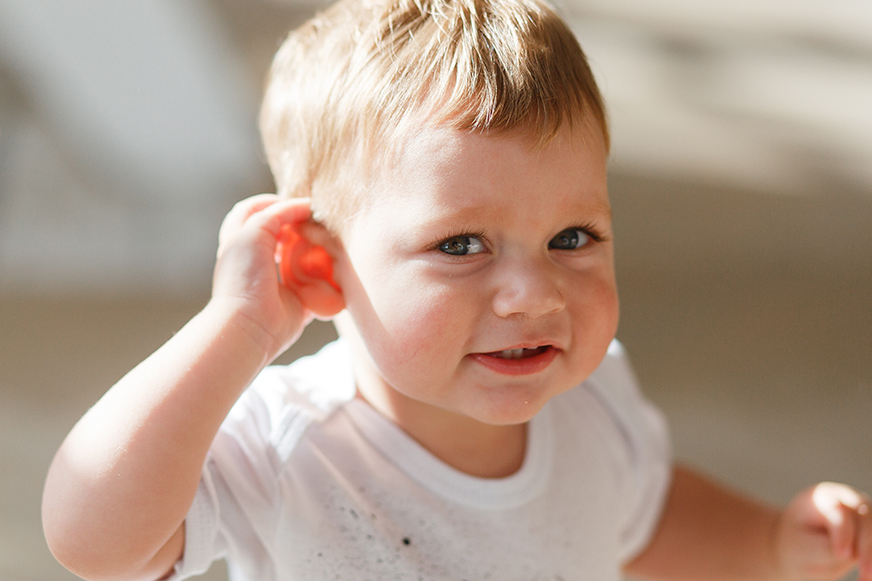
Hearing in Infants (Newborn Hearing Screening)
Early detection of hearing loss in newborns is essential for healthy language development and social growth.
Hearing is one of the most critical senses for a baby’s physical, emotional, and cognitive development. From birth, infants rely on auditory and visual stimuli to develop communication skills and interact with their environment.
If hearing loss is not detected early, it can negatively affect speech development, academic performance, social interaction, and emotional well-being. The earlier a baby begins to perceive sounds clearly, the more natural and healthy their language and social development will be.
For this reason, newborn hearing screening tests are routinely performed before hospital discharge. These tests are essential for identifying hearing impairments early and initiating timely intervention and rehabilitation.
Development of Hearing in Infants
From birth to age 2, hearing development follows a predictable pattern:
- From birth:
- Babies respond to loud sounds with a startle reflex
- From 3 months:
- Human voice becomes the most important stimulus
- Between 6–9 months:
- The baby turns their head toward the source of sound
- After 10–12 months:
- The baby responds when their name is called
- After 12 months:
- The baby begins to respond to simple verbal commands
- Between 18–24 months:
- Vocabulary develops, and hearing can be assessed through speech
In infants with severe or total hearing loss, the startle reflex to sound may not be present.
How Is Newborn Hearing Tested?
Newborn hearing screening requires specialized, reliable, and painless testing methods.
The most commonly used screening test is the Otoacoustic Emission (OAE) Test:
- Soft sounds (clicks) are delivered into the baby’s ear
- The inner ear (cochlea) responds by producing echoes
- These responses are measured and analyzed using a computer
This test:
- Is completely painless
- Takes only a few minutes
- Is usually performed while the baby is asleep
- Does not require anesthesia or sedation
A small soft probe is placed in the outer ear canal, and the baby’s response to sound is recorded.
Importance of Early Diagnosis
Early diagnosis allows:
- Immediate intervention and treatment
- Early use of hearing aids or other devices if needed
- Support for speech and language development
- Prevention of long-term developmental delays
Sıkça Sorulan Sorular
Hearing in Infants (Newborn Hearing Screening) hizmeti hakkında en çok merak edilen sorular ve cevapları.
İşitme testleri genellikle doğumdan hemen sonra, hastaneden taburcu olmadan önce yapılır.
Yüksek seslere tepki vermeme, sesin geldiği yöne dönmeme ve konuşma gelişiminde gecikme işitme kaybı belirtisi olabilir.
Hayır, otoakustik emisyon testi tamamen ağrısız, güvenli ve kısa sürede yapılan bir tarama testidir.